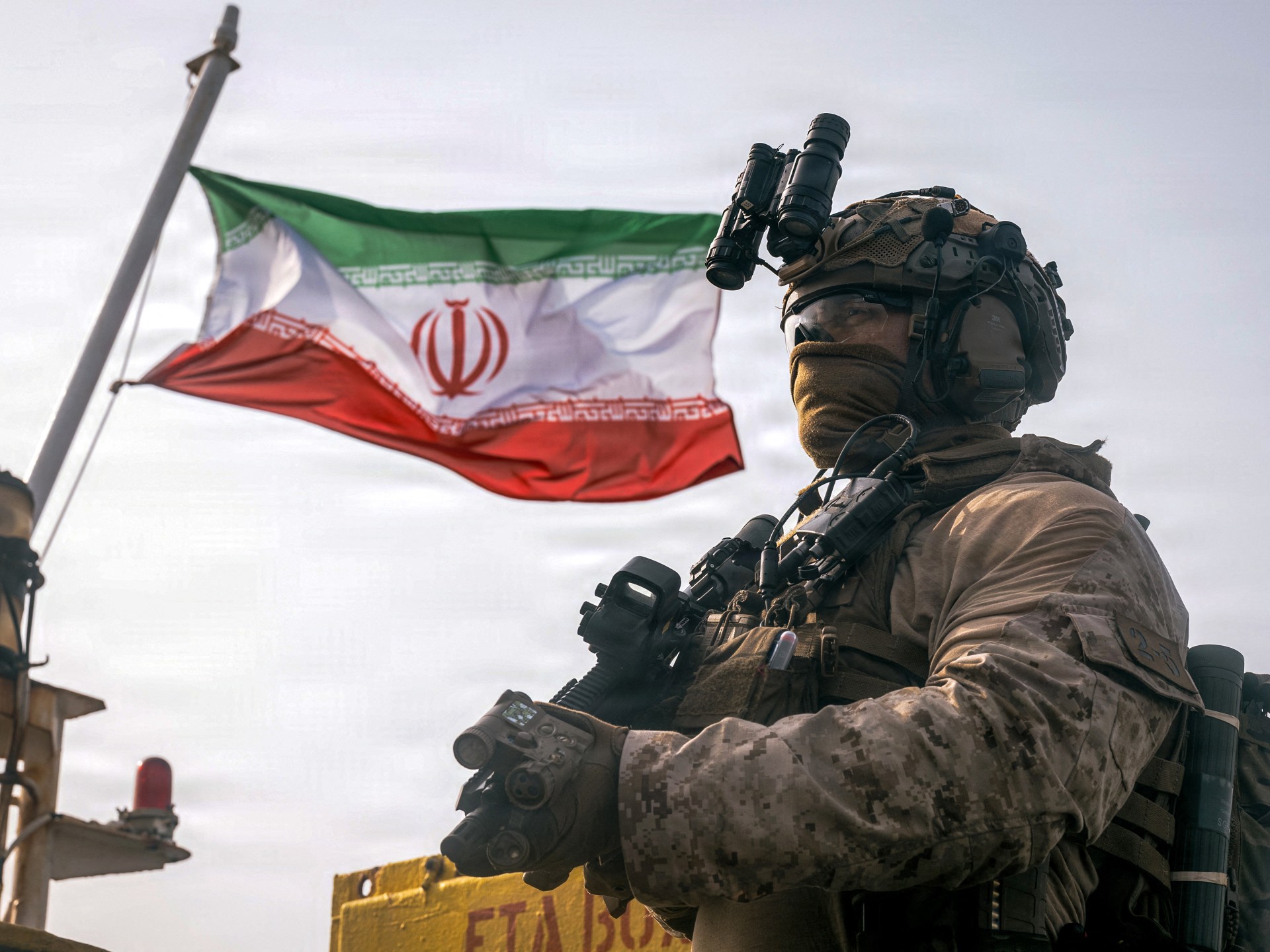

The United States has attacked Iran for a ninth consecutive night after the US military’s Central Command (CENTCOM) announced a US soldier had died in northern Iraq in a controlled detonation of unexploded ordnance from a downed Iranian drone.
Here is what happened over Sunday night and Monday morning and what officials on both sides have said:
Where was Iran attacked?
CENTCOM announced in a statement on X that it completed the ninth wave of attacks against Iran at 02:00 GMT on Monday.
It said it “targeted Iranian military command centers, air defense and coastal surveillance sites, maritime capabilities, missile and drone launch sites, and communications networks to further diminish Iran’s ability to attack commercial vessels and civilian mariners transiting the Strait of Hormuz”.
The US military did not provide details about the actual sites hit in Iran.
Iran’s Islamic Revolutionary Guard Corps (IRGC) said two oil tankers “exploded” and were halted in the southern Strait of Hormuz late on Sunday, according to a report by the semiofficial Tasnim News Agency on Monday.
The IRGC stated the vessels were trying to transit through the strategic waterway under what it described as US coercion.
“This passage is unsafe for the transport of chemical fertiliser or even a single drop of oil and gas,” the group warned, adding that the corridor would remain unsafe as long as US military operations in the region continue.
An MQ-9 drone was intercepted and shot down over Eslamabad-e Gharb in western Iran’s Kermanshah province, according to the Mehr News Agency on Monday.
Advertisement
Mehr said the drone was targeted by an advanced air defence system operated by the IRGC aerospace force.
Iran’s semiofficial Tasnim News Agency reported on Monday that US strikes targeted an area in the town of Khormoj in southwestern Iran. It quoted a local official.
Where did Iran strike, and where were warnings issued?
Jordan: The IRGC said on Monday that it launched ballistic missiles at US C-17 transport planes and P-8 aircraft at Aqaba airport, claiming several were heavily damaged. In a statement carried by the state-controlled IRIB broadcaster, the IRGC also said 20 hangars housing US forces in the Muwaffaq Salti Air Base in Azraq were destroyed.
Bahrain: The US embassy in Bahrain said it has information suggesting Iran may seek to target unspecified locations in central Manama. It urged Americans to remain vigilant, follow instructions from local authorities and immediately seek shelter if warning sirens sound or explosions are heard.
US soldier in Iraq: A US service member was killed in northern Iraq on Saturday during the controlled detonation of unexploded ordnance from an Iranian drone, CENTCOM said.
What happened in the Strait of Hormuz?
The United Kingdom Maritime Trade Operations (UKMTO) agency reported late on Sunday that a vessel about 8 nautical miles (15km) northwest of Kumzar, Oman, had caught fire.
It is unclear whether this happened due to an attack by Iran. The UKMTO said the cause of the fire had not been verified and advised vessels in the area to transit with caution and report any suspicious activity while authorities investigate.
What have Iranian and American leaders said?
US President Donald Trump said on Sunday that the US is hitting Iran to honour American service members who have been killed.
“We hit them very hard again tonight, and we did that in honour of the, probably three, it’s probably three great patriots,” Trump told reporters as he returned to Washington, DC, after the World Cup final in New Jersey. At least two US soldiers were killed in Jordan last week after Iranian missiles struck a US base there, and the third soldier Trump referred to was killed in Iraq during the detonation of the Iranian drone.
“We feel very badly,” he said when asked about the military fatalities, adding that those who died were fighting so “Iran cannot have a nuclear weapon.”
Iranian Foreign Minister Abbas Araghchi said in an interview with state media that Tehran would end the war with the US when it had “the upper hand in the field”, local news reported on Monday.
Advertisement
Talking with the IRNA news agency, Araghchi said the most critical decision in crisis management was identifying the precise moment to halt hostilities and begin negotiations.
“The end of the war is possible either through absolute military victory or through negotiations. The right time to negotiate is precisely when you have achieved a reliable field and strategic achievement on the military front,” Araghchi said.
“You cannot take risks with the lives of the people and the fate of the entire country. Decisions must be made based on accurate and complete calculations,” Araghchi said.
Related News
Zelenskyy urges urgent efforts in Ukraine to start Patriot production
Iraq signs deals with Western oil firms, including to revive Syria pipeline
NATO summit begins: Who is attending and what is at stake?