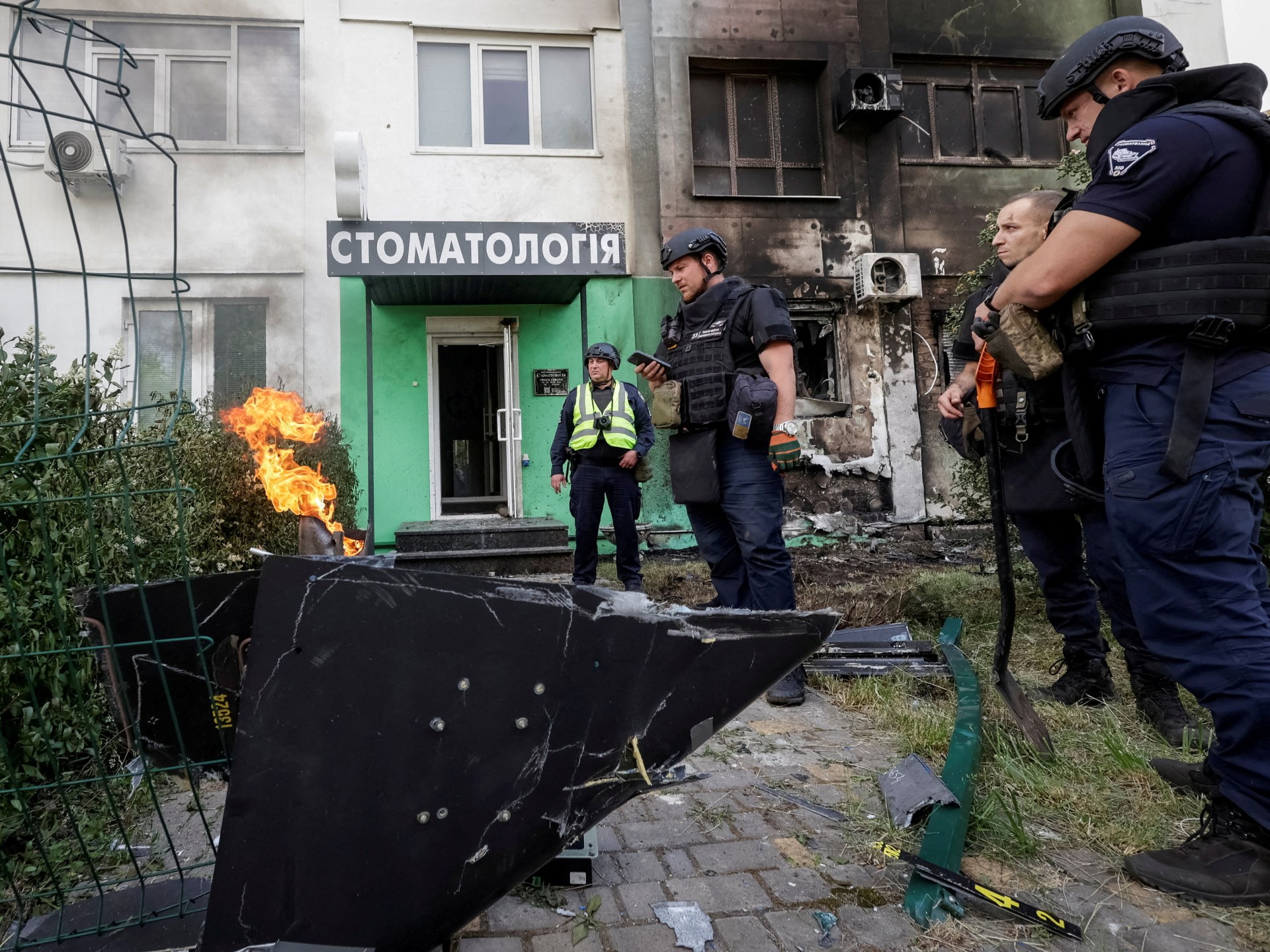

Ukraine said it reclaimed more of its territory than it lost during May, reversing a Russian trend of monthly net gains.
“The ratio of liberated and lost territories is almost 100 square kilometres (40 square miles) in our favour,” wrote Ukrainian commander-in-chief Oleksandr Syrskii on his Telegram messaging channel.
- list 1 of 4Ukraine strikes occupied Mariupol port, Russia’s key oil refineries
- list 2 of 4‘People on edge’: Baltic states fear Russia-Ukraine war spillover
- list 3 of 4Ukraine-made ‘Flamingo’ missile hits target 900 km inside Russia
- list 4 of 4Three killed as Ukraine and Russia exchange cross-border attacks
end of list
Ukrainian defence news outlet Militarnyi estimated net gains slightly higher, at 120 sq km (46 sq miles), citing sources within the military. Militarnyi said Russia seized 130 sq km (50 sq miles) and lost 250 sq km (100 sq miles) during the month.
The Institute for the Study of War, a Washington-based think tank using open source geolocated information, assessed Ukrainian gains higher still, saying Russia had seized or infiltrated 40 sq km (15 sq miles) in May but lost control of about 280 sq km (108 sq miles).

The ISW believed Ukraine actually reversed Russian gains in April, when it estimated Moscow’s gains at 28 sq km (11 sq miles) of Ukrainian land and lost 116 sq km (45 sq miles).
The ISW’s assessments suggest Ukrainian gains are growing.
Syrskii said Ukraine reclaimed 600 sq km (230 sq miles) during the first five months of 2026.
However, Russia was successful on one part of the front
Ukrainian military observer Kostyantyn Mashovets reported on June 10 that Russian forces had advanced into eastern Konstiantynivka, the southernmost of a “fortress belt” of four cities in the eastern region of Donetsk. Russian forces first infiltrated parts of the city last October, and now hold about 13 percent of it, said the ISW.

Russian President Vladimir Putin has prioritised the capture of the remaining one-fifth of Donetsk he does not possess, but his set deadlines to achieve this have been missed several times.
Advertisement
Putin may be putting out feelers for potential ceasefire talks. Although on June 5 he rejected a call from Zelenskyy for direct talks, Zelenskyy said he had met with Russian oligarch Roman Abramovich who acted as Putin’s intermediary.
Ukraine says its battlefield achievements are thanks to a strategy of disrupting Russian supply lines by striking fuel and ammunition in warehouses and in transit.
“The logistical lockdown is working,” said Ukrainian Defence Minister Mykhailo Fedorov. “The number of hits on enemy targets at a distance of over 50km (30 miles) from the (frontline) has doubled,” he said, comparing May to April.
Syrskii put the May total at almost 2,000 strikes.
The effects of Ukraine’s strategy have begun to build up.
Weeks of attacks in the southern regions of Kherson and Zaporizhia reduced Russian military traffic by more than 70 percent along the M-14 motorway, the main east-west route, said Robert Brovdi, commander of Ukraine’s Unmanned Systems Forces.

On June 7, regional authorities prohibited traffic along the M-14 altogether, Brovdi said.
That forced Russian planners to route more supplies along two highways that reach Kherson and Zaporizhia, via Crimea – the E105 and E97.
The following day, Ukraine struck a bridge that shoulders the E105 over the Chonhar Strait, leaving only the E97 passable. On June 9, as about 50 Russian fuel and ammunition trucks were routed to the E97, Ukrainian forces ambushed and destroyed some of them at Armyansk, commander Dmitry Filatov told Suspilne Radio.
“This operation would not have been possible if other units had not struck at Mariupol and the road to Berdyansk,” Filatov said, referring to the mainland routes. “This is what led to the units stationed in the Hulyaipil direction starting to be supplied, not via the Mariupol highways, but via Crimea.”
Civilians in Crimea have faced severe fuel shortages as a result of Ukrainian strikes, and these became dramatically worse in the past week.
On June 7, Sevastopol occupation governor Mikhail Razvozhaev rationed fuel to 20 litres per car per day. He later changed that to 20 litres per week.
Shortages were reportedly forcing troop evacuations from some outlying positions.
The Ukrainian underground group Atesh, which operates in Crimea, said Russian units were abandoning their positions on the Kinburn Spit because they were running out of food and fuel.
“We will create conditions under which it will be extremely difficult for military personnel and defence industry workers to remain in Crimea, in the temporarily occupied territories, or to use the routes leading to them,” Brovdi told Reuters.
Advertisement
Although Russia’s air force continues to command the skies over eastern Ukraine and to drop large ordnance there, Ukraine’s own figures suggest its drone superiority is the more effective tool.
Ukrainian short-and medium-range drones hit 180,000 targets in May, said Syrskii, 12.7 percent more than in April.
Ukrainian defenders are also reportedly becoming more adept at shooting down Russian Shahed drones with their own interceptor drones. Although Russia launched 25 percent more Shaheds in May compared to April, shoot-downs increased by 50 percent to about 4,000, said Fedorov,
Fedorov expected a step-change in Shahed elimination once a new generation of interceptor goes into full production which “automates 95 percent of the entire interception process”.
Beyond these mid-range strikes, Ukraine has also continued a successful long-range strike campaign that has devastated Russian refineries, oil depots and offloading terminals, reducing Russian oil production and export revenue.
Russian recruitment is low
Aware of the Ukrainian drone threat, Russia has created unmanned systems units of its own but appears to be having trouble manning them.
Since the beginning of the year, 14,500 people have signed contracts to serve in these units, about 21 percent of the annual recruitment target, said Syrskii. Overall, Ukraine has killed or wounded 12,500 more troops than Russia has been able to recruit this year, he said.
That is both because casualty figures have been rising since last autumn there – Ukraine estimated 31,500 Russian casualties in May – and because Moscow’s recruitment has been falling, despite increased bonuses to sign-up.
Russian opposition source Vazhnye Istorii said 71,200 people had been paid enlistment bonuses in the first quarter of 2026 according to budget data, compared to almost 90,000 in the first quarter of 2025.
It estimated that recruitment in 2025 was already 10 percent lower than in 2024.
Related News
Violence escalates in Israel amid ultra-Orthodox military draft protests
Armenians go to polls in test of PM’s pivot to Europe amid Russian pressure
EU sanctions ‘extremist’ Israeli settlers in occupied West Bank