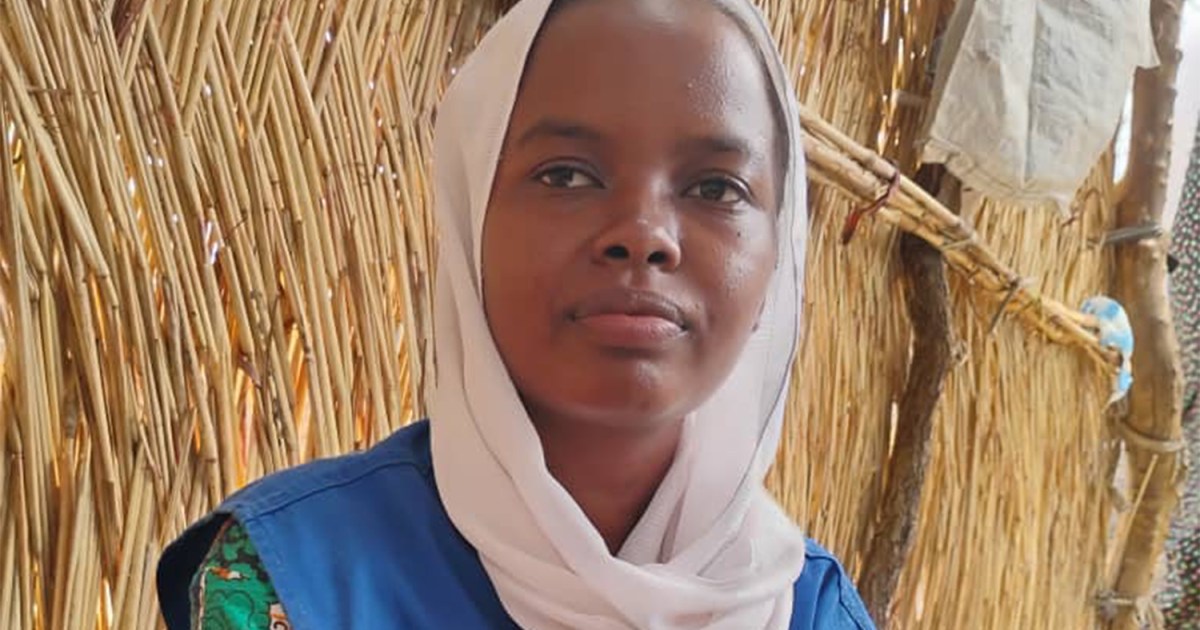

Birao, Central African Republic – When Islam Ibrahim fled Sudan after her father was killed during the siege of el-Fasher, she thought she had escaped the worst of the war.
The 20-year-old pharmacy student fled with her mother and six sisters to the neighbouring Central African Republic (CAR), leaving behind her pharmacy studies.
Now in Korsi refugee camp, she spends her days helping newly arrived Sudanese women and girls. Drawing on the medical knowledge she gained before war interrupted her studies, she volunteers to support refugees arriving exhausted after dangerous journeys from Darfur.
But even in exile, Islam says she cannot escape the pressures that followed her from home.
Her uncles have travelled to the refugee camp urging the family to return to Sudan, so her mother can settle her late father’s estate. Islam fears that returning would not only place them back in an active conflict zone but also expose her and her sisters to pressure to marry relatives against their wishes.
“I only want to go back to Sudan if it’s to continue my education,” Islam told Al Jazeera. “I don’t want to go back to Darfur to divide my father’s inheritance.”
Islam’s story is echoed across Korsi refugee camp, where an entire generation of Sudanese students is trying to salvage futures interrupted by war.
More than 30 Sudanese university students interviewed over several days described lives put on hold by a conflict that has uprooted families, shattered ambitions and left many wondering whether they will ever return home. Most are in their 20s and come from Amdafock, a border town in Darfur that became both a refuge and later a departure point as families fled escalating violence.
Advertisement
Many believed their displacement would be temporary. They imagined returning home to complete their degrees once the fighting stopped.
Instead, that hope has grown increasingly distant.
Their experiences reflect a wider educational divide created by Sudan’s war. Millions of school pupils and university students in Darfur and other areas controlled by the Rapid Support Forces (RSF) have now gone more than three years without regular schooling or access to nationally recognised examinations. In contrast, despite repeated disruptions caused by the conflict, many students in areas held by the Sudanese army have gradually returned to classrooms and sat their exams, widening disparities in educational opportunities between young people on opposite sides of the war.
Lost years
Amdafock was recently seized by fighters from the Seleka rebel coalition operating across the border in the CAR, further diminishing any realistic prospect of return for many of the families originally from the town.
With support from UNHCR, dozens of Sudanese refugees have secured places at the University of Bangui, offering a fragile path back into education after years of disruption.
But returning to university has proved far from simple.
![Baderelddian Issa dreams of completing his university education despite the challenges of life in exile [Zeinab Mohammed Salih/Al Jazeera]](https://www.aljazeera.com/wp-content/uploads/2026/07/IMG_2800-1-1783602170.jpg?w=770&resize=770%2C513&quality=80)
Having completed their schooling in Arabic, they must now study in French, learning an entirely new language while trying to keep pace with university demands. Many say the additional years required, coupled with financial hardship and the psychological toll of displacement, make it feel as though they are losing time they can never recover.
“We have already lost so many years,” several students told Al Jazeera.
Among them is Gamar el-Shaikh, a sociology student at the University of Bangui.
“We left Birao refugee camp, promising our loved ones that we would return with university certificates,” Gamar told Al Jazeera. “But with the educational environment we are in, and all the difficulties we face, it feels almost impossible to keep that promise.”
Another student, Baderelddian Issa, said his family fled after his father, an imam in Amdafock, was persecuted by the RSF for criticising them during sermons at the mosque.
Baderelddian told Al Jazeera that his father’s position made the family a target, forcing them to flee Sudan for the CAR, where he is now trying to continue his studies, while watching the possibility of return slip further away.
Advertisement
Painful choices
For some students, displacement has demanded even more painful choices.
Intisar el-Sadig lost her husband during the war before fleeing to the CAR with her young child. After UNHCR secured her a place at the University of Bangui, she made the difficult decision to leave her three-year-old son in Korsi refugee camp with her mother so she could continue her studies in the capital.
She travels back whenever she can, but says every separation is painful.
“I am studying because I don’t want this war to take everything from us,” Intisar told Al Jazeera. “If I stop now, then we will have lost not only our home and my husband, but also our future.”
![Gamar El-Shaikh is studying sociology at the University of Bangui after fleeing Sudan's war [Zeinab Mohammed Salih/Al Jazeera]](https://www.aljazeera.com/wp-content/uploads/2026/07/IMG_2803-1-1783602167.jpg?w=770&resize=770%2C513&quality=80)
Ahmed knows how quickly those hopes can collapse.
Before the war, he was studying law and dreamed of becoming a judge. His father, a Sudanese army officer, was killed during the fighting in el-Fasher. The family fled to Nyala, believing they had reached safety, but Ahmed says fighters from the RSF attacked them there. During the assault, his mother was beaten so severely that her arm was broken.
The family eventually reached the CAR.
Now living in exile, Ahmed’s studies have been put on hold, and his ambitions have narrowed to survival.
Enduring hope
Across Korsi, that sense of loss is shared in different ways.
Students who once imagined futures as pharmacists, judges, engineers, teachers and academics now spend their days navigating life in exile, learning a new language and trying to rebuild their education in an unfamiliar system while worrying about relatives still trapped in Sudan.
For young women like Islam, displacement has also brought renewed pressure over inheritance and marriage. For others, the loss is measured in years of interrupted education that may never be recovered.
Islam continues volunteering in the camp, while Gamar, Baderelddian and Intisar persist with their studies despite extraordinary obstacles. Ahmed still clings to his dream of becoming a judge.
For these young Sudanese, education has become both refuge and resistance, a fragile attempt to rebuild meaning in lives shattered by war.
“We are the lost generation of Sudan,” Ahmed told Al Jazeera through tears. “We lost everything in this war.”
Related News
Impeachment trial of Philippine Vice President Sara Duterte begins
Iran’s Khamenei funeral: Which world leaders are attending?
Ivory Coast vs Norway: FIFA World Cup Round of 32: Prediction, how to watch