
Damascus, Syria – Authorities have tightened security across Damascus following a series of bomb blasts that have shaken the Syrian capital and tested the limits of the country’s transitional government.
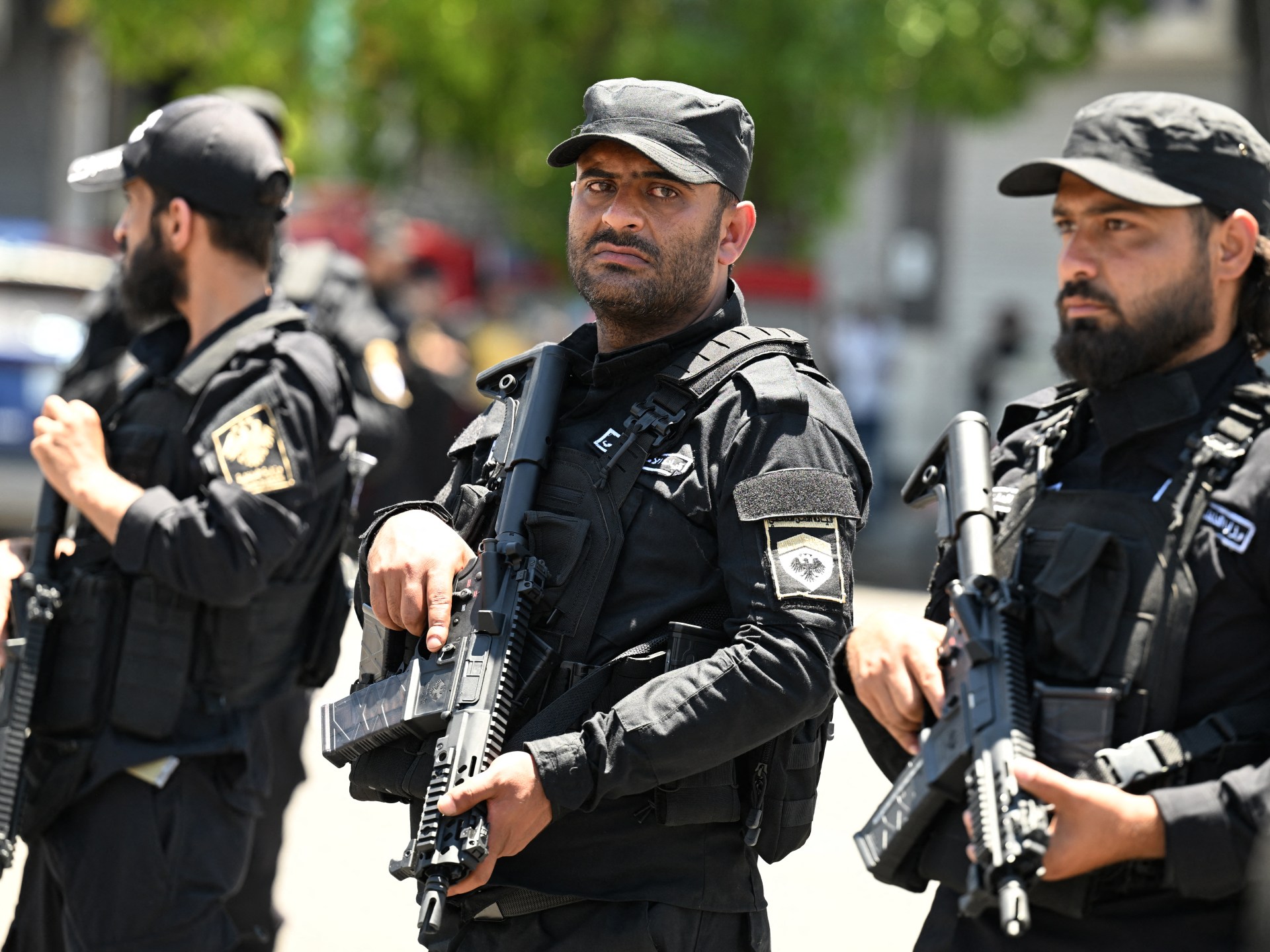
The Ministry of Interior implemented a series of precautionary protective measures, including heavily armed patrols, following a deadly explosion at a cafe on July 2 and a twin bombing on Tuesday during a visit by French President Emmanuel Macron.
Checkpoints have been re-established at critical intersections across the city, while key government buildings, judicial institutions and foreign diplomatic sites have been granted extended exclusion zones, reinforced by concrete blast walls and mandatory vehicle searches.
In the latest attack, two improvised explosive devices – one hidden in a roadside rubbish bin and another rigged inside a parked car – detonated at approximately 10:15am (07:15 GMT) while bomb disposal teams were preparing to defuse them.
At least one person was killed and 36 were wounded in the highly coordinated attack that took place relatively close to the hotel where Macron had spent the night, but outside the security perimeter designated for the French delegation and posed “no direct threat” to the president, according to authorities.
Securing the capital
Special security units have since launched sweeping field operations, utilising localised surveillance footage to track the ownership of the vehicle used in the bombing and scanning urban infrastructure for potential secondary devices.
Advertisement
“Checkpoints and patrols may help people feel safer, but preventing this type of attack requires intelligence work, mapping networks, monitoring explosive materials, improving information sharing and building cooperation with local communities,” said Navvar Saban, a researcher in security and military affairs at the Arab Center for Contemporary Studies in Syria.
Speaking at the scene of the attack, Interior Ministry spokesperson Nureddin al-Baba said the explosions posed “no direct threat” to Macron and confirmed authorities had already identified possible perpetrators, without elaborating. “A short while ago, we discovered an initial lead pointing to those responsible,” he said.
Officials pointed to similarities with last week’s powerful explosion at a busy central cafe frequented by lawyers and clerks from the adjacent Palace of Justice that killed at least 10 people and wounded dozens more.
There has been no claim of responsibility for either attack that come some 18 months since the removal of longtime ruler Bashar al-Assad after years of war.
A member of Syria’s security apparatus with knowledge of the investigation into Tuesday’s attack said Syria’s General Intelligence forces have been seizing “large amounts of explosive materials” daily and “explosive drones belonging to the Iranian Revolutionary Guard Corps (IRGC)”.
The source, who chose to remain anonymous because they are not authorised to speak to the media, said “the most active terror cells we’ve seen in central and southern Syria are linked to the IRGC. The attack was carried out by a Palestinian-Syrian linked to Iranian-backed cells.”
Damascus Governor Maher Marwan al-Idlibi noted that while security had generally improved during the post-Assad transition period, “the more Syria attains stability, the more there are those who want to damage it” – a sentiment echoed by both al-Sharaa after their meeting on Tuesday.
“We are not naive about the risks, but they are being managed,” Macron told reporters, noting that “certain groups” were seeking to prevent “Syria’s full and complete reintegration into the international community”.
A high-stakes balancing act
Still, the back-to-back attacks have deeply rattled people in Damascus, challenging the narrative of a peaceful transition.
The government is hard at work to project an image of a functional, modern state capable of attracting international reconstruction funds and cementing Western partnerships – as evidenced by Macron’s signing of more than a dozen bilateral agreements despite the attack earlier in the day.
Advertisement
The transitional authorities have also been revamping the country’s security and military institutions while also reintegrating former al-Assad regime personnel, as well as fighters from the former Syrian Democratic Forces.
Underlining the difficulty of the task, Saban said it is “very important to recognise that security institutions are still being rebuilt after many years of conflict”.
For many Syrians, the sweeping road closures, hyper-vigilant patrols and rampant rumours on social media stir dark memories of the country’s protracted war, increasing fears that the capital remains highly vulnerable to asymmetrical warfare.
As Damascus settles into an uneasy quiet under the watch of newly deployed security forces, observers say the transitional leadership faces a razor-thin balancing act: It must successfully suppress internal security threats without suffocating the very sense of normalisation and civic openness it needs to legitimise its rule.
Saban said the increased security measures alone will not be enough to end attacks like the ones over the past week.
“The cost barrier for preparing these types of explosives is relatively low,” he added.
“That’s why the security institutions need to shift from reactive security measures following an attack to preventative security measures based on real-time intelligence to stop these attacks using human and signal intelligence gathering, as well as advanced threat analysis.”
Related News
Reform UK’s Farage failed to disclose funds from convicted criminal: Report
Israeli attacks on Gaza and occupied West Bank kill two, including child
Burnham pledges devolution and discipline if he becomes UK prime minister